Battle, Capybara!
- 4.7
- Rating
- 100.00K
- Installs
- Free
- Price

 Analysis by App-foxy
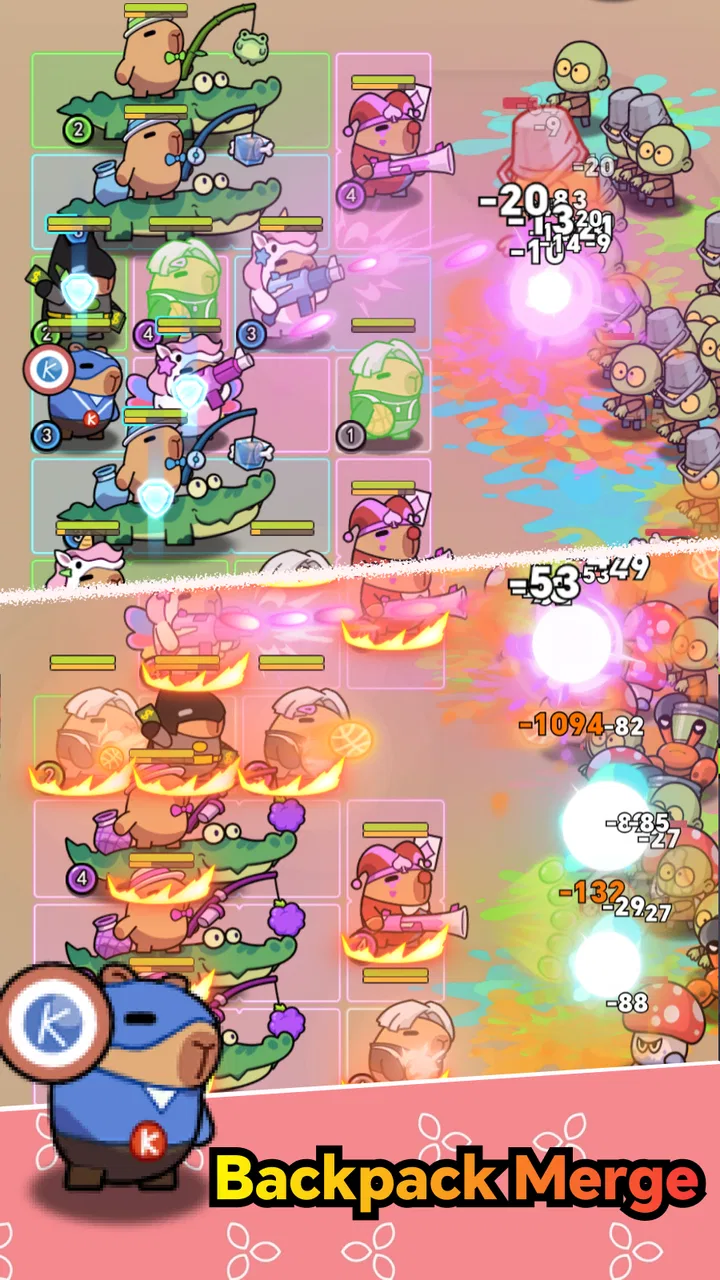
I spent time with Battle, Capybara! as a light strategy game, and my first impression was that it is much easier to pick up than many games in the same category. The capybara theme gives it a friendly personality, while the backpack-merging and tower-battle idea points toward short decisions rather than a long, complicated campaign. That makes it especially interesting for shared-device households, where one person may want a quick turn and another may prefer to think through a small tactical problem.
The game is free, developed by crt, and listed for Everyone. It has reached over one hundred thousand installs and holds a 4.7 average from around seven hundred ratings, which suggests that its approachable style has connected with a healthy number of players. I would not treat those figures as a substitute for personal experience, but they do match what I noticed: this is designed to be welcoming first, demanding second.
How it fits into a shared household
The most natural use case is a spare-minute game on a phone or tablet that several people in the home can understand without a long explanation. Someone waiting for dinner, taking a short break, or sitting beside another player can open it and begin working through its battle-and-merge loop. The capybara presentation also helps here. It feels less intimidating than a serious military strategy game, so a younger player or a relative who normally avoids complex games may be more willing to try it.
You May Also Like

 Blood Strike: 2.5 Anniversary
Blood Strike’s Loadouts Turn Every Drop Into a Tactical Gamble
A close look at Blood Strike’s custom loadouts: how fast access to signature weapons reshapes its battle royale rhythm, rewards preparation, and narrows the gap between fights.

 Pandora - Music & Podcasts
Pandora’s Music Is Easy to Start, but Harder to Recover
Pandora’s strength is its low-effort path from a seed to a station. Its weak spot is how much confidence it asks you to place in connection, setup, and quiet recovery.

 8 Ball Pool
 Is Built on Rivalries, Rematches, and Routine
A close look at the rivalries, rematches, shared routines, and unanswered safety questions that turn a quick pool match into a persistent mobile community.

 Samsung Music
’s Quiet Strength Is Playing What You Already Own
Its reach comes less from spectacle than from dependable access to a personal library. That simplicity is both the app’s strongest retention engine and its ceiling.

 AccuWeather: Weather Radar
AccuWeather Review: A Quick, Clear Forecast for Everyday Decisions
For everyday plans, the best forecast is the one you can understand quickly. AccuWeather makes rain timing, radar, and local conditions easy to act on, with a few trade-offs.

 Hill Climb Racing
Why Hill Climb Racing Still Turns Crashes Into One More Run
A tiny car, a bumpy hill and one more upgrade: Hill Climb Racing keeps resurfacing because its simple chaos makes every near-miss feel personal.
More From Our News Desk



I can imagine a simple household routine: one person plays a few encounters in the evening, then hands over the device so someone else can experiment with the backpack arrangement. That exchange is more enjoyable when the game presents choices clearly. Instead of requiring a large amount of reading before the first meaningful action, the central appeal comes from deciding what belongs together and how those choices support the next fight.
There is a useful distinction between shared play and multiplayer play. I would not assume that two people are controlling the same battle at once. The stronger shared-device scenario is taking turns, discussing choices, or passing the device around. If your household specifically wants live competition or cooperative control, a conventional multiplayer strategy title will probably be a better fit. This game makes more sense as a casual strategy toy that invites conversation than as a substitute for a dedicated head-to-head game.
That difference matters when choosing where to install it. On a family tablet, its visual tone and Everyone rating make it an easy candidate for casual use. On a personal phone, it works well when I want something more interactive than a puzzle but less demanding than a full strategy campaign. The same game can serve both situations, although the household version benefits from agreeing who is taking the next turn before someone rearranges a carefully prepared backpack.
What the core loop asks you to notice
The interesting part is not simply merging items because the game suggests it. The better question is what the merge changes about the next battle. A stronger object may be useful immediately, but combining too freely can also reduce the number of separate options available in the backpack. I found that the most satisfying decisions came from resisting the obvious merge for a moment and considering whether flexibility would be more valuable than a single upgraded piece.
That is a small but important strategy lesson. New players can focus on making visible improvements, while experienced players will naturally begin to think about space, timing, and the shape of the next encounter. Even without turning the game into a spreadsheet exercise, it rewards a pause before tapping. In a shared household, this creates a good handoff moment: the next player can explain why an item was kept separate or why a merge was worth the sacrifice.
My practical advice is to avoid treating every empty backpack space as a problem that must be solved instantly. Space is useful because it preserves choices. When the board or backpack starts to feel crowded, look for the merge that improves your plan rather than the one that merely clears the most room. That habit is more valuable than rushing through every available combination.
Setup, boundaries, and the first session
Getting started should be straightforward for anyone using a compatible Android device. The listed minimum operating system is Android 7.0, so the game is not limited to only recent phones. I would still install it on the device that will actually be used most often and spend a few minutes learning the basic rhythm before handing it to a child or another family member. That prevents the first shared session from becoming a series of guesses about what each tap does.
The current version is 1.1.4. In practical terms, that is useful to know when two household devices behave differently after one has been updated and the other has not. I would keep the installation current where possible, but I would not promise that updating creates identical progress or settings across devices. If several people use one device, decide in advance whether the game belongs to one player or is a communal run.
That boundary is more important than it may sound. A shared game can become frustrating when one person spends time building a preferred setup and another changes it without asking. I recommend treating the backpack as belonging to the current player for the duration of a session. A quick verbal rule such as “finish this battle before switching” avoids most arguments and keeps the strategy meaningful.
I also prefer a short first session rather than immediately trying to master everything. Let the player learn what merging feels like, observe how battles respond, and then stop while the choices still feel fresh. This is particularly helpful for younger users, because the cute presentation may suggest a simple toy while the arrangement decisions still require attention. The game is approachable, but approachable does not mean every choice is consequence-free.
Coordinating turns without overcomplicating play
For a household, coordination works best when it stays informal. I would not create a complicated schedule for a game built around quick sessions. Instead, use natural moments: one person plays after breakfast, another takes a turn later, or the device is passed after a battle rather than in the middle of preparation. This keeps the game from becoming a source of interruptions.
A particularly good shared routine is to let the incoming player inspect the backpack before making changes. That turns the handoff into a small strategy discussion. The previous player can point out which item was being saved, while the next player can decide whether to continue that plan or try something different. It gives both people ownership without requiring simultaneous access.
There is also a useful way to divide play by temperament. A cautious player may prefer organizing the backpack and preserving options, while an impulsive player may enjoy testing a bold merge. Both approaches can be entertaining, but they should not be mixed unknowingly. If one person is experimenting and another expects careful progress, agree whether the session is for discovery or for advancing a shared run.
That distinction helps answer a common household concern: can different people enjoy the same installation without wanting the same thing from it? Yes, if expectations are clear. The game is flexible enough to support relaxed experimentation and more deliberate planning, but the device owner should remember that a single shared progression can make those goals collide. If preserving individual progress is essential, separate devices or separate supported profiles would be preferable where available; I would not assume that one installation automatically provides account separation.
Age, trust, and the role of the adult
The Everyone content rating makes the game easier to consider for a broad age range, and its capybara theme is clearly less severe than the presentation of many battle-focused strategy games. Still, an age label does not tell me how every child will respond to competition, failure, or repeated attempts. I would let a younger player try it while an adult is nearby, then judge whether the pace and decision-making suit that child.
The adult’s main role is not to manage the game for the child. It is to establish sensible device habits and explain that a cute style can still contain meaningful choices. A child who understands that merging is a decision, not just a reward animation, will get more from the game. I would also encourage taking turns honestly and asking before changing another person’s arrangement.
Trust matters because casual games often become shared possessions inside a household. Even without discussing technical account features, the social boundary is clear: do not reset, reorganize, or spend another player’s effort without permission. That advice applies especially when the game is installed on a family tablet used by several people. The game can support friendly cooperation, but the cooperation comes from the players, not from assuming the device will protect every personal preference.
For adults choosing a game for a child, I would describe this as a supervised casual strategy option rather than a fully hands-off activity. The Everyone rating is reassuring, but supervision is still useful for setting limits, checking whether the child understands the goal, and preventing arguments over shared progress. For teens and adults, the same guidance is less necessary, although clear turn boundaries remain helpful on a communal device.
Where it stands beside other strategy games
Compared with traditional turn-based strategy games, this one is lighter and more immediately readable. You are not choosing from a large map, managing a long list of resources, or learning a dense set of factions before the game becomes interesting. That is its biggest advantage for newcomers and for anyone who wants a short session with some thought behind it.
Compared with pure merge games, the battle context gives each combination a reason to exist. You are not only chasing a bigger object or a cleaner collection. The arrangement has tactical meaning because it relates to what happens in combat. Players who enjoy organizing items but want more purpose than a simple matching loop may find this balance appealing.
The trade-off is depth. If your favorite strategy games are built around extensive planning, varied maps, diplomacy, or long-term empire development, the capybara format may feel narrow. Its charm comes from focusing the decision space, not from trying to reproduce a desktop strategy experience on a small screen. I would choose it for accessible tactical moments, not for a grand campaign that occupies an entire weekend.
It also differs from action games because the satisfaction is less about reflexes and more about preparation. If you want constant movement or precise timing, this will likely feel too measured. On the other hand, that slower emphasis makes it suitable for playing beside someone else, discussing a choice, or pausing to think without feeling that the game is punishing you for looking away.
Small habits that improve the experience
My first useful habit is to inspect the whole backpack before merging. The fastest visible combination is not always the best one, especially when a separate item may be needed to complete a more useful arrangement. This is the kind of detail that a quick store description cannot communicate, but it makes the difference between tapping randomly and actually playing strategically.
Second, use shared sessions to compare decisions rather than to dictate them. If a child or new player chooses a different merge, let the result teach both of you something. The game becomes more enjoyable when the household treats mistakes as experiments instead of correcting every move immediately. That approach also helps a new player develop an independent sense of timing.
Third, separate learning sessions from progress sessions. On one turn, deliberately test an unfamiliar combination; on another, preserve a reliable setup and move forward. Mixing those goals can make the game feel inconsistent, particularly when several people share one run. Naming the purpose of the session takes pressure away and makes handoffs much smoother.
Finally, stop when the decisions become automatic. The game works best as a compact strategy break, and forcing a long session can flatten the charm of the merge-and-battle rhythm. I would rather return later with a clear head than keep tapping after I have stopped thinking about why an item belongs where it is.
Who should install it and who should skip it
I would recommend it to players who like friendly presentation, short strategy sessions, and inventory decisions that have a direct connection to battles. It is particularly well suited to households sharing a tablet, parents looking for an approachable game to try with a child, and experienced players who want something less demanding between larger games.
I would be more cautious if you need deep account separation, guaranteed live multiplayer, or a large-scale strategy system. I would also skip it if the appeal of strategy for you depends on complex economies, expansive maps, or a long narrative campaign. The focused design is a strength for casual play, but it is also the reason the game may not satisfy players seeking a highly elaborate challenge.
Because it is free, the barrier to trying it is low, but free does not automatically mean frictionless for every household. The real cost may be shared attention: deciding whose turn it is, protecting another player’s arrangement, and accepting that one installation may not serve everyone’s preferred style equally well. Those are manageable issues, yet they are worth considering before presenting it as a communal family game.
My household verdict
After playing it, I see Battle, Capybara! as a cheerful, compact strategy game that works best when its limits are understood. The capybara theme makes the invitation friendly, while the backpack decisions give the battles enough structure to reward thought. I especially like how naturally it can become a pass-the-device game, provided everyone agrees on turn boundaries and respects the current arrangement.
Its Everyone rating, free price, broad Android compatibility, and current 1.1.4 release make it easy to try on a household device. The strong 4.7 average and more than one hundred thousand installs also show that it has found an audience, though I would still judge it by the needs of the person who will actually play. The game is not a replacement for a deep strategy classic or a live multiplayer experience.
My recommendation is to treat it as a shared, short-form strategy game rather than a permanent family competition. Give each player a clear turn, pause before merging, and use the backpack as a place for discussion instead of frantic tapping. In that role, it is approachable, distinctive, and easy to recommend to a friend who wants battles with a softer personality and just enough planning to make each choice matter.
FAQs for Battle, Capybara!
01What is the main objective of Battle, Capybara!?
In Battle, Capybara!, the main objective is to lead your capybara troops to victory against various opponents. Players must strategically deploy their capybaras, each with unique abilities, to overcome challenges and defeat enemies in different levels and environments.
02Is Battle, Capybara! available for both Android and iOS devices?
Yes, Battle, Capybara! is available for download on both Android and iOS platforms. Users can find it on the Google Play Store and the Apple App Store, ensuring compatibility with a wide range of devices. Always check the system requirements before downloading.
03Are there in-app purchases in Battle, Capybara!?
Battle, Capybara! offers in-app purchases that allow players to buy various items and upgrades. While the game is free to download, these purchases can enhance the gameplay experience by unlocking special abilities, new capybara skins, and additional levels.
04Does Battle, Capybara! require an internet connection to play?
Battle, Capybara! can be played offline, allowing users to enjoy the game without an internet connection. However, certain features, such as multiplayer battles and leaderboards, require an internet connection to function properly. Players can switch between offline and online modes seamlessly.
05How does Battle, Capybara! ensure player progress is saved?
Battle, Capybara! automatically saves player progress through cloud synchronization, provided the player is connected to the internet. This feature allows players to continue their game on different devices without losing progress. Ensure you have a stable internet connection for seamless syncing.
Pros
- Engaging and colorful graphics.
- Easy to learn for all ages.
- Offers regular updates.
- Great sound effects enhance gameplay.
- Offline mode available.
Cons
- In-app purchases can be costly.
- Occasional ads interrupt play.
- Limited character customization.
- Some levels feel repetitive.
- Requires frequent updates for bug fixes.

Battle, Capybara!
Gallery